
Advancing child safety through signal sharing
Every day, the world’s leading tech companies share critical intelligence on threats to child safety through Lantern, using that information to make their platforms safer, removing abusive material and bad actors.
Why Lantern exists
Offenders exploit gaps between platforms, services, jurisdictions, and industries to evade detection and continue harming children online. Because online child sexual exploitation and abuse (OCSEA) often spans multiple services, no single company can effectively address this threat alone.
Lantern was created to strengthen cross-platform collaboration against OCSEA. Participating companies can securely share signals related to violative activity, helping identify harmful behavior and content that may have otherwise gone undetected, uncover patterns of abuse, and strengthen enforcement across platforms and services.
Launched in 2023, Lantern has evolved into a growing industry infrastructure supporting coordination action against online child exploitation.
How Lantern works

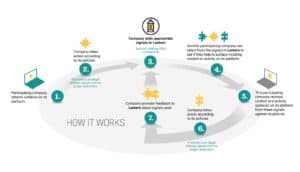
When a company detects OCSEA on its platform, it takes action in accordance with its child safety policies and legal obligations. Through Lantern, the company can also securely share a signal—information that may help other companies identify OCSEA occurring on their own platforms.
Participating companies that receive signals independently assess the information and investigate potential violations of their own privacy policies and terms of service before taking action. These signals can help companies identify new forms of abuse or provide additional context to better understand activity already under review.
Lantern signals can provide a crucial piece of the puzzle to uncover active threats to children.
What are signals?
Signals are threat indicators, intelligence, or other information associated with OCSEA that may help participating companies identify harmful activity on their platforms. Participating companies determine which signals to share and ingest based on their policies, legal obligations, use cases, and assessments of relevance.
Types of signals
Content-based signals relate to material being shared online, including known child sexual abuse material (CSAM), grooming manuals, or other illegal images, video, audio or text.
Examples include:
- Hashes of known CSAM that can be used to detect and prevent redistribution
- URLs linking to webpages that host OCSEA content
- Keywords or codewords used by offenders to evade detection in sharing or engaging with CSAM.
Incident-based signals relate to behavior, interactions, or events that violate child safety policies.
Examples include:
- Reports of repeated unsolicited contact with minors
- Attempts to move conversations with minors off-platform
- Payment requests or extortion language targeting minors
By sharing these signals, participating companies can better detect evolving threats and identify offenders attempting to exploit gaps between.
Financial sector participation
Financially motivated abuse, including financial sextortion and the commercial distribution of CSAM, increasingly rely on cross border payment systems and digital financial services.
Participating financial institutions engage with Lantern on a receive-only basis, meaning they can ingest relevant signals shared by participating tech companies to support investigations to potential violations of their own policies and terms of services.
The Tech Coalition continues to take a measured and risk-based approach to financial sector participation, evaluating each institution individually to ensure compliance with Lantern’s legal, operational, privacy, and security requirements.
- Accounts engaged in grooming or solicitation of minors to create explicit content
- Indicators of financial sextortion
- Patterns suggesting coordinate abuse across services.
By sharing these signals, companies help one another detect evolving threats, and respond more effectively – closing the gaps predators can exploit between platforms.
Lantern’s impact
Signals being shared in Lantern are producing tangible outcomes and helping to protect children from cross-platform abuses.
2023 – 2025
2,047,982
Signals shared through Lantern
353,806
Platform enforcement actions
Enforcement actions break down to:
164,575
Accounts
163,112
URLs
26,119
Pieces of content
FAQs
Who is eligible to apply to Lantern?
Lantern is open to qualifying tech companies and financial institutions that demonstrate a firm commitment to combating OCSEA and meet the program’s requirements.
NGOs, governments, law enforcement agencies, researchers, and other non-industry organizations are not eligible to participate.
How do I apply to Lantern?
Please fill out our interest form with your information. Our team will review your eligibility and follow up regarding next steps.
Where is the information stored/ who hosts the tech for Lantern?
Lantern is hosted on the ThreatExchange platform, a secure information-sharing platform developed by Meta.
ThreatExchange enables organizations to securely share signals in a manner designed to support privacy, security, and responsible cross-industry collaboration.
What governance and safeguards does Lantern have in place?
Lantern incorporates governance, privacy, security, and human rights safeguards designed to support responsible signal sharing.
Participating companies must complete a vetting process and demonstrate their ability to securely manage signals, conduct appropriate investigations, and comply with applicable legal obligations.
Lantern does not facilitate automated enforcement actions. Participating companies independently review signals and determine whether enforcement actions are appropriate under their own policies and legal obligations.
Lantern participants
38 companies currently participate in our Lantern program, including:






























Learn more about Lantern
If you’re interested in understanding more about Lantern or exploring whether it’s a fit for your platform, our team are happy to talk.
Get in touchLantern has improved the way we combat child exploitation by enabling us to see the bigger picture across platforms. Through this coordinated effort, we’ve been able to take decisive action against harmful accounts and behavior more efficiently and at a larger scale. By sharing threat intelligence with other platforms, we’re not just protecting Discord, we’re part of a cross-platform collaboration that’s creating a safer internet as a whole.

Jud Hoffman
Vice President of Trust & Safety
Discord